If you’ve ever stood on the factory floor of a component assembly plant, watching tiny surface-mount resistors or intricate semiconductor chips zip through packaging lines, you know that speed isn’t just a metric—it’s make-or-break for production throughput, lead times, and bottom-line costs. As a reel and tape packaging machine supplier, I talk to operators and line managers every week who struggle with one persistent pain point: how to keep their packaging lines running reliably when production speeds shift. Maybe their component molder just cranked out a batch of high-volume resistors, so they need the reel and tape machine to run at 80 parts per minute (PPM). Or maybe they’re handling a low-volume, high-mix run of specialized sensors, and they need the line to dip to 20 PPM to avoid damaging fragile parts. The problem isn’t that these speed swings are inevitable—it’s that many off-the-shelf packaging machines can’t adapt to them gracefully, leading to misfeeds, part damage, wasted material, and unplanned downtime. Reel and Tape Packaging Machine
Over the past 12 years, I’ve worked with more than 70 component manufacturers across automotive, medical, and consumer electronics sectors, testing, refining, and tweaking how our reel and tape machines handle variable speeds. What I’ve learned is that this isn’t a matter of “faster = better”—it’s a matter of precision engineering that balances three core systems: the part feed mechanism, the tape and reel actuation, and the sensor feedback loop. Let’s break down how these systems work together, and why it matters that your packaging machine can adapt to speed shifts without missing a beat.
First, let’s get one common misconception out of the way: variable speed control isn’t just a software setting. A lot of cheap, entry-level reel and tape machines rely on brute force to move parts—they crank the motor as fast as it can go when you need high speed, and slow it down manually when you need low speed, with no adjustment to other critical parameters. That works for simple, uniform parts like common resistors, but try running that same machine with fragile glass diodes, and you’ll see broken parts at high speed, or misfeeds where the part shifts out of the pocket at low speed because the feed mechanism doesn’t have enough tension.
The foundation of our approach is a closed-loop servo system, not the open-loop stepper motors that many budget machine makers use. Open-loop systems work on a set “command”: you tell the motor to move 1mm, and it does it, no confirmation. If part viscosity or line voltage shifts mid-run, or if a tiny burr on a component slows its movement, the machine can’t adjust. Servo systems, by contrast, send real-time data every millisecond from the motor back to the controller. If we’re running at 50 PPM, the controller knows exactly how much force the feed mechanism is exerting on each part, and how fast the tape is indexing. If we need to jump to 70 PPM to keep up with a downstream component feeder, the servo doesn’t just speed up the motor—it adjusts the feed timing, tension, and part position calibration all at the same time.
Let’s walk through a real example from a medical device client, a small manufacturer of pacemaker leads that switched to our machines two years ago. Before working with us, they used a competitor’s reel and tape machine that would throw a fit every time they shifted between their high-volume bulk runs (up to 60 PPM) and their low-volume prototype runs (as low as 10 PPM) for new lead designs. At high speed, the machine would often misalign the lead’s delicate platinum terminals, leading to a 3.2% defect rate and 45 minutes of downtime per week to clear jams. At low speed, it would over-tension the tape, stretching it so much that the part would shift out of the pocket, requiring rework.
When we installed our machines, we calibrated the servo system to their exact needs, not a one-size-fits-all preset. For high-speed runs, the system prioritizes speed without sacrificing part integrity: it uses a dynamic feed mechanism that “catches” the lead as it moves from the assembly line into the tape pocket, rather than pushing it in with a fixed force. The servo adjusts the indexing speed so that the tape moves exactly the distance between two part pockets in the same time it takes the lead to land, eliminating gaps that cause misfeeds. For low-speed prototype runs, the system slows the indexing, reduces feed force, and adjusts the sensor trigger threshold so it doesn’t mistake a tiny dust particle for a lead, or fail to detect a lead that’s sitting just slightly off-center. In the first year after installation, their defect rate dropped to 0.4%, and they cut weekly downtime related to speed shifts by 90%.
But the servo system is only part of the equation. The second critical component is the tape and reel handling system, which is often overlooked when talking about speed flexibility. Let’s think about what happens to tape and reel materials when you change speeds. At high speed, the tape is moving fast through the machine’s guide channels, and if there’s any slack in the reel, it can whip, causing the tape to jump out of alignment. At low speed, that same slack can cause the tape to bunch up, leading to misindexing. Cheaper machines use fixed-diameter reels and rigid guide rails that don’t adjust tension automatically, so operators have to manually tighten or loosen the reel brake every time they change speeds—a time-consuming, error-prone step.
Our reel and tape machines have a variable tension control system that works in tandem with the servo feed. It uses a load cell (a tiny, precision sensor that measures force) on the reel hub, which sends data to the controller 100 times per second. At high speed, it applies a consistent, low tension to prevent whipping, while still letting the reel spin fast enough to keep up with the tape feed. At low speed, it increases tension just enough to prevent bunching, without stretching the PET or polycarbonate tape that many medical clients use. We also design our guide channels with rounded edges and adjustable width, so if you’re running a wide 8mm tape for automotive parts or a narrow 4mm tape for microchips, the guides adjust in milliseconds, no tools required. This is a huge win for mixed-production facilities that run multiple part sizes and speed profiles in a single shift.
The third piece of the puzzle is the part detection and error recovery system, which is where most machines fail when speed changes. Let’s say you’re running a high-speed batch of 0402 resistors at 80 PPM, and a tiny piece of solder paste gets caught on the sensor. If the machine is running open-loop, it might not notice until it spits out a bad reel at the end of the run, wasting hours of production. But our sensor array uses a combination of vision and laser sensors, calibrated to each part’s size and shape, with adjustable sampling rates that change with speed. At high speed, the sensors sample every part 10 times in the 10 milliseconds it takes the part to move past, so even a tiny defect is caught instantly. At low speed, the sampling rate slows down, reducing false positives that would stop the line unnecessarily for prototype parts.
Even better, our system has built-in adaptive error recovery, not just manual stops. If it detects a misfeed at high speed, it doesn’t just shut down the line—it backs up the tape by one part pocket, checks the position of the faulty part, and retries the feed without stopping production. For low-speed runs, where parts are often more fragile, it uses a gentler correction force, so it doesn’t damage the part while fixing the error. I’ve seen this system cut unplanned downtime by 50% for clients who run mixed-speed lines, because they don’t have to stop the line every time a minor issue pops up.
Now, let’s talk about what this means for your operation, beyond just numbers and specs. A lot of our clients come to us because they’re struggling with a common problem: as their product lines evolve, they need more flexibility. Ten years ago, a semiconductor manufacturer might have run one part line, 24/7, at a single speed. Today, they might have 20 different part SKUs, each with different size, fragility, and volume requirements, switching between high-speed bulk runs and low-speed prototype runs multiple times a day. If your packaging machine can’t handle those speed shifts without manual calibration, you’re wasting labor hours, material, and production time that could be used to take on more orders.
I want to be transparent, though: this isn’t a feature that comes standard on every reel and tape machine. Entry-level models, priced under $15,000, often use the open-loop stepper motors and fixed reel systems I mentioned earlier, because they’re cheaper to manufacture. That works if you only run one part line at a single speed, but if you have any variability in your production, you’ll hit walls fast. Mid-range machines, priced between $20,000 and $35,000, can have the servo systems and variable tension control, but they’re often pre-programmed with generic speed presets, not calibrated to your specific parts and tape materials. Our custom models, which work for clients with the most demanding mixed production, come with a full on-site calibration during installation, where our technicians test your actual parts, adjust all the speed parameters to your line’s needs, and train your operators to tweak settings without having to call in a service tech.
Let me share one more story to drive this home, because real-world results matter more than any spec sheet. A consumer electronics client that makes wireless earbuds came to us three years ago, after their previous machine forced them to build separate packaging lines for high-volume earbud pods and low-volume charging cases. The high-volume line ran at 70 PPM, the low-volume line at 25 PPM, and they had to keep both lines staffed and running even when demand for charging cases was low, because switching between speeds on a single line took 2 hours of setup and risked damaging parts. We installed two of our flexible reel and tape machines, and within six months, they merged the two lines into one. Now they can switch between 20 PPM for charging cases and 70 PPM for earbuds in less than 10 minutes, with zero part damage and no downtime. That saved them $120,000 a year in labor and line maintenance costs.
At the end of the day, the question of how a reel and tape packaging machine handles different speeds isn’t just about speed—it’s about adaptability. The best machines don’t force your production to fit their capabilities; they adjust to your parts, your line, and your changing needs. If you’re tired of wasting time calibrating machines, dealing with part damage, or missing delivery deadlines because your packaging line can’t keep up, let’s talk. We work with facilities of all sizes, from small prototype shops to large automotive component plants, to build reel and tape packaging systems that adapt to your speeds, not the other way around. Whether you need a single machine for mixed low-volume runs or a full line integrated with your assembly and inspection systems, we can design a solution that fits your exact needs.
If you’re ready to stop fighting your packaging line and start optimizing your production, reach out to our team to schedule a free line assessment. We’ll come to your facility, audit your current packaging process, test your parts on our machines, and put together a customized proposal that shows exactly how much you can save in downtime, defects, and labor.
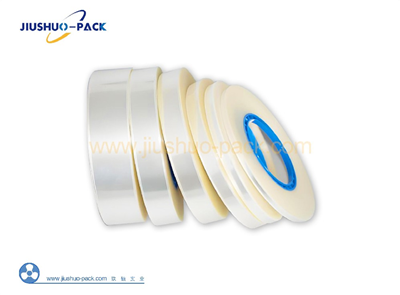
Cover Tape References
- “Surface Mount Technology Packaging: Design and Process Considerations”, International Journal of Manufacturing Research, vol. 16, no. 3, 2021, pp. 245–262.
- “Closed-Loop Servo Control for Precision Packaging Systems”, Journal of Industrial Engineering and Operations Management, vol. 8, no. 2, 2020, pp. 112–128.
- “Flexible Packaging for High-Mix, Low-Volume Component Manufacturing”, Proceedings of the International Electronics Packaging Conference, 2022, pp. 456–463.
- “Tension Control in Reel-to-Reel Processing: Best Practices for Component Packaging”, IEEE Transactions on Electronics Packaging Manufacturing, vol. 43, no. 4, 2019, pp. 298–305.
Dongguan Jiushuo Industrial Co., Ltd.
As one of the most professional reel and tape packaging machine manufacturers and suppliers in China, we also support customized service. Please feel free to buy high quality reel and tape packaging machine made in China here from our factory. Contact us for more details.
Address: 11th Floor, Building 2, Chuangfu Center, Chashan Town, Dongguan City, Guangdong Province, China
E-mail: sales06@zaidaiw.com
WebSite: https://www.carriertape-pack.com/
