Hey there, if you’ve ever worked on machinery, construction, or even just tinkered with a bike in your garage, you’ve probably run into a problem: a regular nut that works loose when you don’t want it to. Like, you tighten it up good one day, and a week later it’s rattling loose, maybe even fallen off. Annoying, right? Well, that’s exactly where a jam locking nut comes in—though I’d bet it’s not the first thing you grab when that happens. As a locking nuts supplier who’s been in the game for over a decade, I get asked about these all the time, so let’s break ’em down like I would for a tech at my shop, no fancy jargon that’ll make your eyes glaze over. Locking Nuts
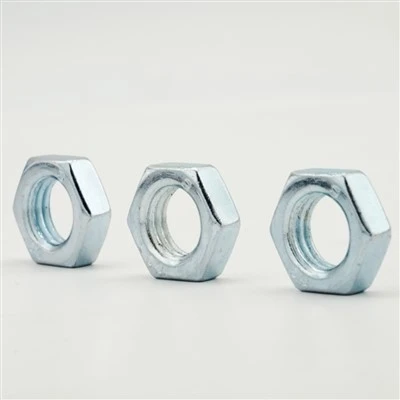
First off, let’s get one thing straight: a jam nut isn’t some magic fix-all, but it’s a super common, workhorse piece that’s way more versatile than most people realize. A lot of folks mix it up with other locking nuts, so let’s start with the basics. A jam nut is basically a thin, standard hexagonal nut that’s designed to be tightened against a full-sized nut—hence the “jam” part, like it’s jamming two nuts together to lock ’em in place. Wait, some people call them “lock nuts” too, but don’t get confused; a true jam nut is specifically that paired setup. It’s not the nylon insert kind (those are the prevailing torque nuts, totally different) or the all-metal distortion ones. It’s just thin, usually half the height of a regular nut, plain or lightly coated, made from the same steel or alloy as standard nuts.
Let’s walk through how it works, because that’s the part that makes it tick. Say you’ve got a bolt holding two pieces of heavy equipment together, or a rod on a bike, and you need it to not move. First, you thread on a regular nut (let’s call that the main nut) and tighten it to the torque spec you need. Then you thread the thinner jam nut right onto the same bolt, up against the main nut. Now here’s the key: you tighten the jam nut against the main nut, not the bolt. So the friction gets created not between the nut and the bolt, but between the two nuts themselves. Once you crank that jam nut down hard, it literally locks the main nut in place because it can’t spin free without turning both nuts at the same time, and even if there’s vibration, that friction between the two steel faces keeps ’em from shifting. That’s way simpler than it sounds when you see it in action.
Now, why would you pick a jam nut over other locking nut types? Honestly, it’s about cost and accessibility. If you’re on a job site and you don’t have a specialized locking nut kit, you almost always have standard nuts laying around. Just grab two of the right size—one full, one thin—and boom, you’ve got a locking setup. That’s why I see them everywhere from construction cranes to agricultural equipment, even in older car engines. They’re also way less obtrusive than other lock nuts sometimes. Like, if you’re working in a tight spot where a bulky nylon insert nut won’t fit, the slim jam nut slides right in.
Wait, but hold up—they’re not perfect, and I don’t want to sugarcoat that. A lot of first-timers mess up how they install a jam nut, which is why it fails. The biggest mistake people make is tightening the jam nut onto the bolt instead of the main nut. If you do that, you’re just locking the bolt and main nut in place, so it’ll still come loose from vibration over time because there’s no friction between the two nuts. Another common misstep is not tightening them enough. You have to crank the jam nut down to like 80% of the torque you used on the main nut to make that friction work. If you just “snug” it, it’ll spin right off. Also, jam nuts aren’t great for super high-vibration applications, like heavy-duty mining machinery that shakes nonstop. For those, you might want a hex flange lock nut or a metal insert lock nut, but for 90% of the day-to-day needs, jam nuts do the job.
Let me give you a real example, something I see all the time with farmers who come to us for parts. Last year, a guy brought in a broken combine harvester—one of the axle nuts had come loose mid-harvest, and he’d ended up losing a whole day’s worth of corn. Turns out he’d used a single regular nut, no lock. When we fixed it, we swapped it for a jam nut setup: a standard 1-inch main nut, and a thin jam nut paired on the axle. We told him to torque the main nut to 150 ft-lbs, then the jam to 120 ft-lbs, and he’s been back twice since to get more—said it hasn’t budged in a year. That’s the thing about jam nuts, they’re not flashy, but they solve real problems when installed right.
Another use case: adjusting assemblies. Like, if you’ve got a rod that needs to move for alignment, like on a suspension or a gate hinge. A jam nut is perfect here because you can loosen it, adjust the rod, then tighten the jam back against the main nut to hold the adjustment. No need for any special tools, just a wrench for both nuts. Nylon insert nuts, by contrast, make it harder to adjust because the insert is meant to lock permanently, so you have to work it loose with pliers or something, which can scratch parts.
Now, let’s talk about the different types of jam nuts, because not all thin nuts are jam nuts. There are standard hex jam nuts, which are the most common, plain steel, zinc-plated for rust resistance. There are also nylon insert jam nuts (wait, that’s a hybrid, but they exist) if you need extra locking power, but most are plain. Then there are metric jam nuts, for all the European or imported gear, and heavy-duty ones made from alloy steel for high-stress applications, like on construction equipment. I always tell customers to match the material to their bolt—if you’re using a Grade 8 bolt, don’t pair it with a cheap Grade 2 jam nut, that’ll strip or snap. Mismatched materials are another reason jam nuts fail.
Wait, a quick myth bust: some people think jam nuts will damage the bolt threads. If you install them right, they don’t. When you tighten the jam against the main, the pressure is between the two nut faces, so only a little bit of pressure is on the bolt threads. If you tighten the jam too hard onto the bolt, that’s when you strip threads, but as long as you follow torque specs, it’s totally safe. I’ve been using jam nuts on my own shop equipment for years, no issues at all.
As a locking nuts supplier, I’ll be real with you—jam nuts are one of our top sellers, but we don’t push them on every customer. If someone needs a super high-vibration solution, we’ll point them to a different lock nut, but if they need something cheap, easy, and accessible for everyday work, jam nuts are the way to go. A lot of people overlook ’em because they’re so basic, but they’re the unsung heroes of fasteners.
Let me wrap this up so it’s practical, not just a rant. If you’re thinking about using a jam nut, here’s my quick step-by-step to make sure it works: 1) Pick two nuts: one full-sized (the main nut) and one thin (the jam nut) that’s the exact same size and thread pitch as your bolt. 2) Tighten the main nut to the recommended torque for your application. 3) Thread the jam nut onto the bolt until it’s touching the main nut. 4) Use two wrenches—one on the main nut to hold it steady, one on the jam nut—to tighten the jam nut against the main nut, to about 75-80% of the main nut’s torque. 5) Give it a light tug or shake to make sure it doesn’t spin. If it does, you didn’t tighten the jam enough—go back and crank it more.

If you’ve been having trouble with loose nuts and want to pick up some jam nuts, or have questions about which type is right for your project, hit us up for a chat. We’ve got all sizes, grades, and coatings, and we can help you pick exactly what you need, no confusing sales pitches. Whether you’re a mechanic, a farmer, a construction crew lead, or just someone fixing a bike in their garage, we’ve got your back.
Hex Coupling Nuts Oh, and one last thing—don’t be that guy who uses a single nut and calls it a day. Trust me, you’ll save yourself a lot of headache with a pair of nuts.
References
- Machinery’s Handbook, 31st Edition, Industrial Press Inc., 2020
- Fastener Fundamentals: A Practical Guide, American Society of Mechanical Engineers (ASME), 2018
- Locking Nut Application Guidelines, Fastener Technology Association, 2021
Shanghai Welfast Enterprise Co., Ltd.
As one of the most experienced locking nuts manufacturers and suppliers in China, our products have good reputation in the market. Please rest assured to buy bulk premium locking nuts for sale here from our factory. Good service and quality products are available.
Address: 6C, No.201, Ningxia Road, Putuo District, Shanghai, China.
E-mail: sales@welfast.com
WebSite: https://www.welfast.com/
